
For too long, enterprises with legacy mainframe estates have been faced with a high-stakes dilemma: continue maintaining their mainframes, essentially kicking the modernization can down the road (they know they will need to deal with it eventually), or perform a dangerous “big bang” migration with many unknowns and risks.
At Google Cloud, we propose an alternative: a modernization strategy that leverages the power of AI, agility of the cloud and allows for iterative and continuous modernization. This approach recognizes a fundamental truth: mainframe modernization isn’t a pure code-to-code conversion problem. Sure, modernizing a single, isolated and small application is relatively easy, especially with recent advancements with AI and large language models. The real challenge lies in modernizing at real-world scale without breaking the intricate web of dependencies and legacy data formats you find in a large global enterprise, all while ensuring functional equivalence.
For example, some of these “real world” challenges include:
-
Application logic is tightly fused directly to legacy and proprietary databases and record schemas.
-
Non-relational formats that are inaccessible by AI Agents, such as VSAM, flat files, IMS hierarchical structures.
-
Transaction monitors like CICS and IMS TM deliver highly integrated transaction management. A single transaction scenario can consist of millions of lines of code.
-
Intricate sequential workflows with complex conditional step logic and dependencies.
-
Internal/external boundaries utilizing proprietary protocols like CTG, IMS Connect, MQ, LU 6.2 Sockets.
-
Deep operational lock-in with specialized proprietary mainframe utility suites.
In other words, real-world modernization of mainframe applications is so much more than converting COBOL to Java. You also need to modernize the underlying data models, handle decades of obscured application dependencies and interfaces and modernize the underlying data stores. Most importantly, you need to validate and de-risk the modern code with actual production traffic before going live.
Our approach combines the advanced reasoning and scale of our Gemini models for code understanding, with mainframe-specific modernization products to address real-world complexity and challenges. Our solutions span four core pillars: assessment, modernization, de-risking, and data migration.

Let’s take a look at each of these.
1. Assessment: AI reverse-engineering of the legacy applications
Our Mainframe Assessment Tool (MAT) reverse-engineers legacy codebases at massive scale to provide both explainability for the current legacy applications and sets the required foundation for modernization.
MAT delivers deep insights into your mainframe environment in four key areas:
-
Dependency visualization: Mapping relationships and interconnectivity between the different applications and data stores, such as DB2 databases or VSAM files.
-
Automated business rule extraction (BRE): Translating complex mainframe application logic into both plain-language requirements and visual decision trees.
-
Automated documentation: Generating comprehensive, up-to-date technical documentation directly from your production mainframe source code.
-
Domain and business function discovery: Automatically identifying application boundaries, grouping applications into high-level business domains and visualizing the architecture for these domains including inputs, outputs, interfaces, and where processing occurs.
MAT gives you the clean, verified logic requirements needed to understand your existing applications and business processes and to design a cloud-native future. By integrating these outputs directly into agentic modernization workflows through MCP, it equips your AI agents with the granular, application-specific context they need to guarantee high-accuracy code transformation, scale execution, and optimize for your own codebase.
Google Mainframe Assessment Tool: Business rule extraction (BRE) from a legacy mainframe application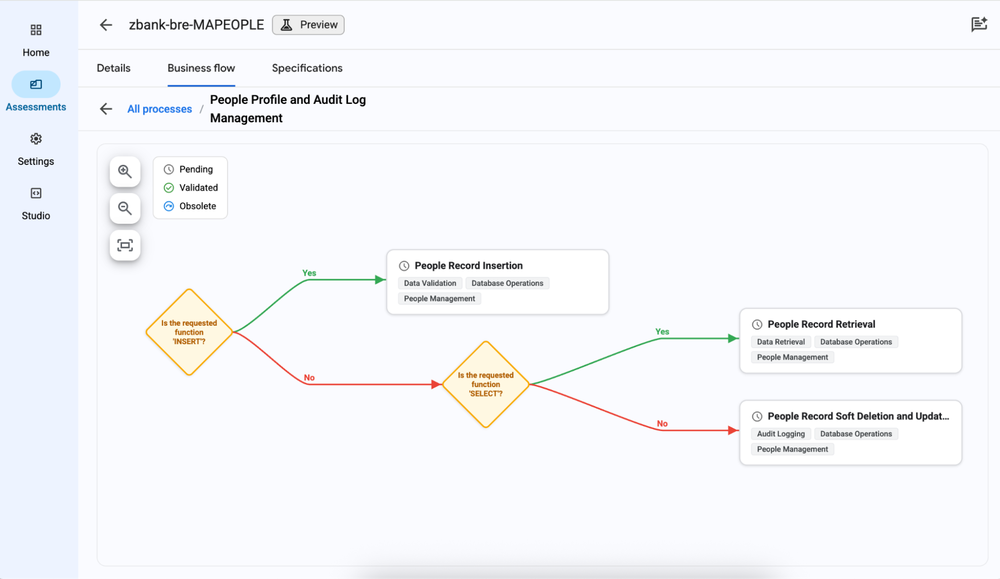
Google Mainframe Assessment Tool: Showing reverse engineering of an application to generate an infographic visualizing inputs, outputs, processing and user interfaces
2. Modernization: code transformation
Modernization requires strategic choices tailored to your desired business outcomes. There is rarely a single path that fits every use case. Our adaptable approach lets you select the exact depth of modernization your business needs, allowing you to apply different strategies to different mainframe workloads.To bridge the gap between theory and execution (aka AI to Applied AI), we partnered with our Mainframe Modernization Professional Services team to build specialized AI agents. These agents directly codify their proven methodologies and hands-on field experience into structured, agentic modernization workflows. With Google’s agentic mainframe modernization solution, you have two ways to modernize:
Rewrite / Reimagine
Choose this path for legacy applications where business logic innovation drives the highest strategic ROI. This pattern relies on the Mainframe Assessment Tool (MAT) to extract business rules together with our Mainframe Modernization Agents to handle forward-engineering. This agentic workflow analyzes and extracts complex business processes to translate legacy code into clear business specifications.
Combined with Antigravity as the agentic harness, this solution provides a safe, AI-accelerated development pipeline with optional human-in-the-loop governance at every step: business rule extraction from the mainframe applications -> creating target application specifications -> creating target architecture design -> generate user stories and backlog -> create the agentic coding implementation plan and more.
This allows engineering teams to decouple complex logic from implementation details and replaces the legacy mainframe “black box” with a transparent, easily maintainable, and highly evolvable cloud-native applications.
Google Mainframe Modernization solutions working together to establish and agentic modernization workflow
Deterministic modernization (like-to-like)
This pattern is designed for use cases that require structural modernization while preserving exact, legacy application behavior. We use AI for direct code-to-code modernization of the internal application structures, using strict contract fidelity as our governing constraint. The modernized system must produce the identical business output as the legacy system for any given input, removing technical debt without altering external application interfaces.
Matching the pattern to the workload
What does modernizing with these two patterns look like in the real world? Imagine a customer in the financial services industry that applies a mixed approach across their estate. They could modernize stable, high-volume back-office batch jobs (like nightly statement processing) with the like-for-like path to reduce MIPS consumption with reduced risk and faster timelines. They might choose deterministic AI modernization for their core general ledger, modernizing the data structure to Google Cloud SQL for better analytics while preserving the regulatory compliance logic. Finally, for applications that are competitive differentiators, such as a customer-facing loan origination platform, they could deploy a rewrite-with-AI strategy, using Gemini to rewrite the application for real-time approvals, creating a true differentiator for the business.
3. The safety net: De-risk before going live
To eliminate go-live risk, Google Cloud Dual Run processes real-world production workloads simultaneously across both your mainframe and your new Google Cloud environment. It automatically captures live mainframe transactions, runs them against your modern applications, and compares the outputs side-by-side (protocols, messages and changes to data). This continuous validation runs until you achieve complete logic and data equivalence, ensuring safety and zero operational disruption before you retire the legacy applications on the mainframe. Global enterprises are already using Dual Run to eliminate migration risk and even secure the strict regulatory approvals needed for modernization in certain industries. Think of Dual Run as your production-grade insurance policy for mainframe modernization success.

4. Data migration: Modernize siloed mainframe data
Finally, with the Google Cloud Mainframe Connector, you can copy data off the mainframe and into various Google Cloud services such as BigQuery, Spanner, Cloud SQL, Cloud Storage, and others. Mainframe Connector handles the codebase and data-type conversions, and can easily be integrated into existing ETL processes to iteratively copy data off the mainframe and onto Google Cloud. Mainframe Connector lets you both offload processing from the mainframe to support both the augmentation modernization pattern as well as analytics/data-warehousing. Now you can unlock siloed mainframe data to create new business functions in the cloud, all while reducing MIPS usage.
Combined, these four solutions demonstrate how targeted applied AI can help solve real-world modernization challenges for mainframe customers: understanding the existing business processes, modernizing the applications, de-risking before going live and modernizing the siloed data.
Put us to the test
Mainframe modernization shouldn’t require a leap of faith. Put our AI-accelerated approach to the test through a targeted pilot program designed to move your enterprise from uncertainty to execution.
Here is how we get started:
-
Automated codebase assessment: Run a Mainframe Assessment Tool scan on a target application to map hidden dependencies, visualize domain architecture, and extract plain-language business rules directly from the legacy code.
-
Agentic modernization workshop and pilot: Collaborate hands-on with Google Cloud experts and specialized partners to showcase the capabilities of how agentic workflows can be applied in the real-world to solve the mainframe modernization problem. Together we can pick one application to modernize and build the business case for modernization.
Ready to get started? Contact us at mainframe@google.com.