
AI agents are the ultimate insiders. We grant them permission to read emails, query databases, and trigger API calls. They don’t just retrieve information, they take action.
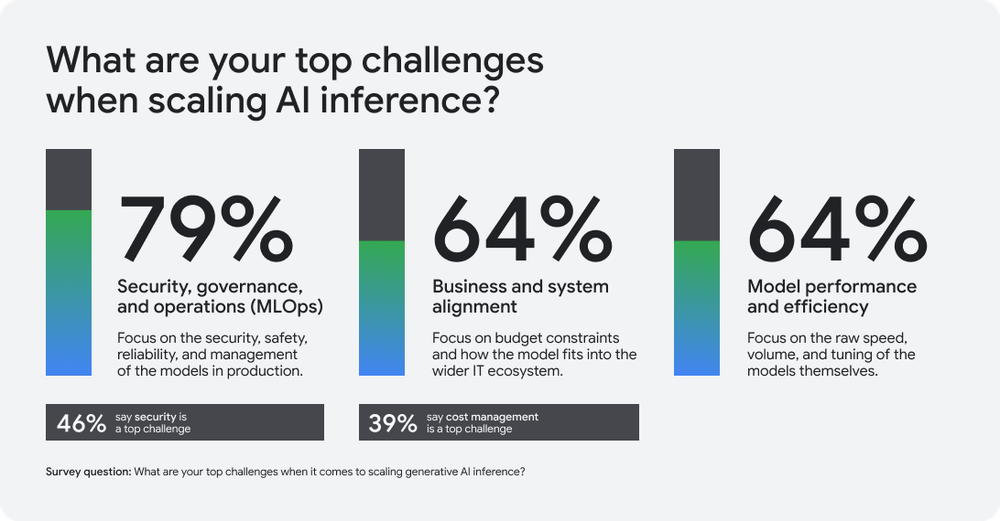
Agents offer incredible potential for increased productivity and better customer experiences, but they also come with new security concerns. In our new State of AI infrastructure report, 79% of tech leaders cite security, governance, or operations as their most significant challenge to scaling inference.
While there’s still a crucial role for traditional security tools, the threat model has fundamentally changed. Autonomous workflows have redefined enterprise risk, so it’s crucial that we give agents the access they need without compromising security.
The agentic paradox
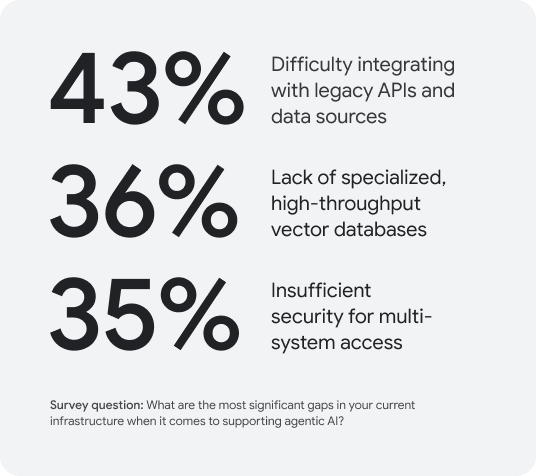
The path to success starts with viewing governance as a driver for innovation. To be useful and secure, an agent needs access — and also guardrails. Yet 35% of senior IT decision makers cite insufficient security for multi-system access as a primary issue preventing agentic deployment.
Agents expand the surface area that defenders need to protect, and can introduce new threats, including tool poisoning and indirect prompt injection, where an attacker can hijack an agent’s logic through the data it processes. Managing the dynamic permissions that agents need to succeed at their tasks can also be a significant challenge, particularly as legacy security wasn’t designed for today’s automated threats.
Securing the chain of thought
Along with securing more identity and access issues, it’s important for defenders to secure both the network layer and the model.
Security leaders are increasingly shifting their focus from preventing breaches to verifying provenance to guard against misuse, including indirect prompt injection.
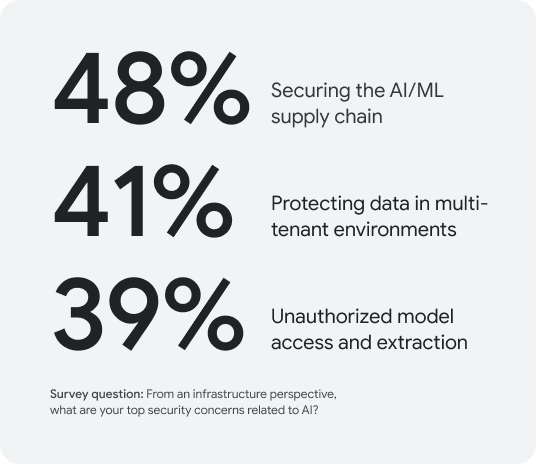
From an infrastructure perspective, what are your top security concerns related to AI?
From blocking to managing
We’ve looked at the new security challenges posed by agentic AI. You can’t solve them by simply locking down the system, as that defeats the purpose of autonomous agents.
Many organizations are turning to integrated, full-stack cloud platforms to give them greater oversight. 69% of surveyed executives now rate a full-stack platform as a critical requirement, and 80% say data compliance is the primary factor dictating that choice.
By adopting frameworks like the Secure AI Framework (SAIF) and moving to a central control plane, purpose-built platforms such as Gemini Enterprise Agent Platform, organizations can manage risk in three main areas:
-
Secure-by-default design: Embedding security directly into the AI development process to proactively guard against threats including prompt injection.
-
Agent governance and oversight: Adopting purpose-built permission and identity management for agents — giving greater control over agent interactions, exposing blind spots and limiting risks tools.
-
Human-in-the-loop control: Enforcing clear rules that automatically flag when an agent requires human approval before moving forward with a critical action.
Governance will guide you to success
The true value of a modern security foundation is its ability to encourage innovation. By embedding robust governance directly into a unified foundation, organizations can deploy agents with confidence across their most sensitive, business-critical workloads.
The leaders of the agentic era are re-architecting their stack to use security as a launchpad — empowering them to innovate securely and scale faster than their competition.
Find out more about how enterprise leaders are rethinking security for the agentic era in the State of AI infrastructure report.