
Network sidecars have a deserved reputation for excessive resource consumption and increased management overhead, especially in a service mesh environment. Today, we are announcing the general availability of ambient networking for Google Kubernetes Engine (GKE). This milestone marks an important evolution in how your run service mesh on GKE, bringing a sidecar-less architecture into production. Introduced earlier this year, ambient networking decouples functionality traditionally provided as a service mesh from application workloads, allowing platform operators and developers to help secure, observe, and route traffic without the resource overhead and operational complexity of managing sidecar proxies.
Ambient networking architecture
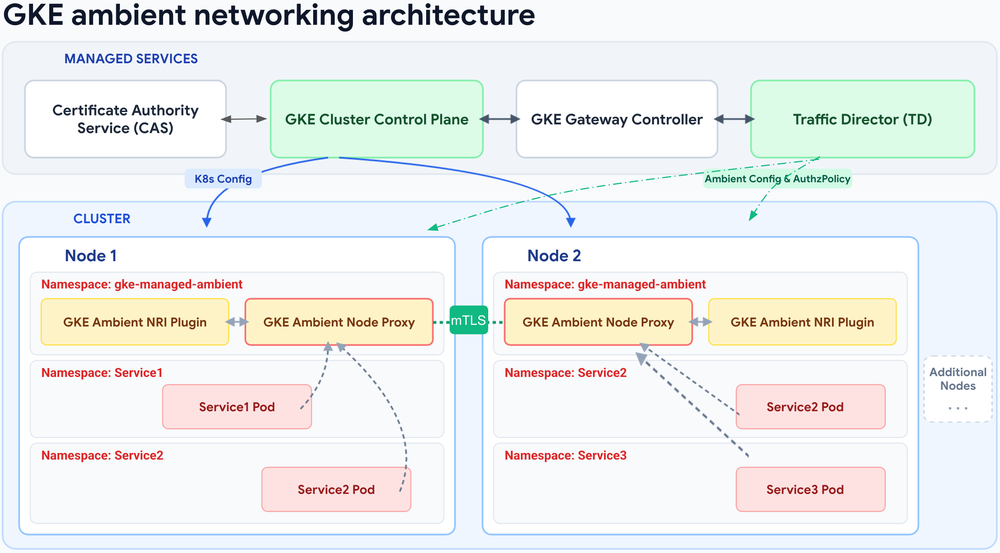
The ambient networking architecture shifts networking responsibilities from individual application pods to shared per-node components and managed control plane services.
Control plane
The ambient networking control plane orchestrates operations across the cluster.
- Traffic Director: Serves as the centralized xDS control plane, continuously delivering routing rules, access control policies, and cluster state updates to node-level proxies.
- Certificate Authority Service: Authenticate workloads and dynamically issues managed workload identity certificates, on-demand to enable seamless mTLS encryption across service-to-service communication.
- GKE control plane: Manages the cluster
- Gateway controller: Reads the Gateway CRDs and passes configuration information to Traffic Director
GKE node components
At the same time, several Node-level management components operate securely within the gke-managed-ambient namespace:
-
Ambient networking runtime interface (NRI) plugin: Integrates with the NRI to perform low-level network redirection, intercepting traffic to and from ambient-enabled application pods.
-
xDS agent (ambient agent): Runs inside the node proxy pod to receive xDS configuration updates from Traffic Director and request certificates from the GKE control plane on-demand.
-
Node proxy (L4 Envoy proxy): A high-performance, shared per-node Envoy instance that processes intercepted L4 traffic, enforces mutual TLS (mTLS), evaluates authorization policies, performs load balancing, and emits rich telemetry metrics.
-
Service pods: The user’s application/service pods communicate through the GKE node proxy to perform service to service mTLS across the cluster.
Core functionality
Together, these features combine to deliver a number of advanced capabilities for GKE environments:
-
Zero Trust architecture: Ambient networking allows customers to establish a Zero Trust security posture. Traffic between workloads can be automatically encrypted using mutual TLS (mTLS) with managed workload identities, helping protect and secure service-to-service communication across the cluster.
- Simplified access policy: Granular control over service communication is simplified through authorization policies. Operators can define precise access rules to enforce least-privilege security boundaries between microservices.
- Rich telemetry: Gain operational insights with out-of-the-box L4 metrics and L7 metrics. Observability data can be collected automatically, giving teams visibility into traffic patterns, latency, and connection health for efficient monitoring and troubleshooting. To see these metrics, use Network Services Monitoring, a new Google Cloud capability that is also available today. Network Services Monitoring shows the traffic that ambient networking handles, for example, service-to-service connections, latency, and error rates, across your GKE clusters, so you can understand service dependencies without building your own dashboards. To learn more, read the documentation.
Ambient networking benefits
Ambient networking delivers tangible value for GKE operators:
-
Simpler operations: Traditionally, service mesh products rely on injecting sidecar containers directly into every workload pod. Ambient networking removes this sidecar dependency by shifting networking features to shared node components. This fully managed solution simplifies deployment and streamlines day-to-day cluster operations.
-
Simplified lifecycle management: When proxy logic is decoupled from application containers, lifecycle management is simplified. Upgrading proxy versions or applying configuration updates helps avoid restarting application workloads or scheduling downtime windows, enabling continuous availability for your services. Ambient networking can reduce administrative overhead and application disruption an average of four times annually by eliminating pod restarts required by CVE patches for L4 mesh usage.
This fully managed solution can be installed either at cluster creation time or added to an existing cluster. Ongoing maintenance to the cluster components is handled by automated systems and is performed along with normal GKE cluster maintenance.
- Reduced resource consumption: By moving away from sidecar proxies for each pod, ambient networking reduces compute and memory overhead. Ambient networking enables up to a 10x reduction in GKE resource usage for layer 4 (L4) mesh features, including mTLS, load balancing, telemetry, and more.
Try ambient networking in your GKE clusters today
Simplifying adoption by removing the cost and complexity barriers of sidecars. Try it out in your GKE environment and experience the benefits of ambient networking:
-
fully managed installation and upgrades
-
service-to-service mTLS and authorization policies
-
lower resource usage than sidecars
-
L4 & L7 metrics
See our documentation for more information: https://docs.cloud.google.com/kubernetes-engine/docs/concepts/ambient-overview
Pricing: https://cloud.google.com/products/gke-service-networking/pricing