
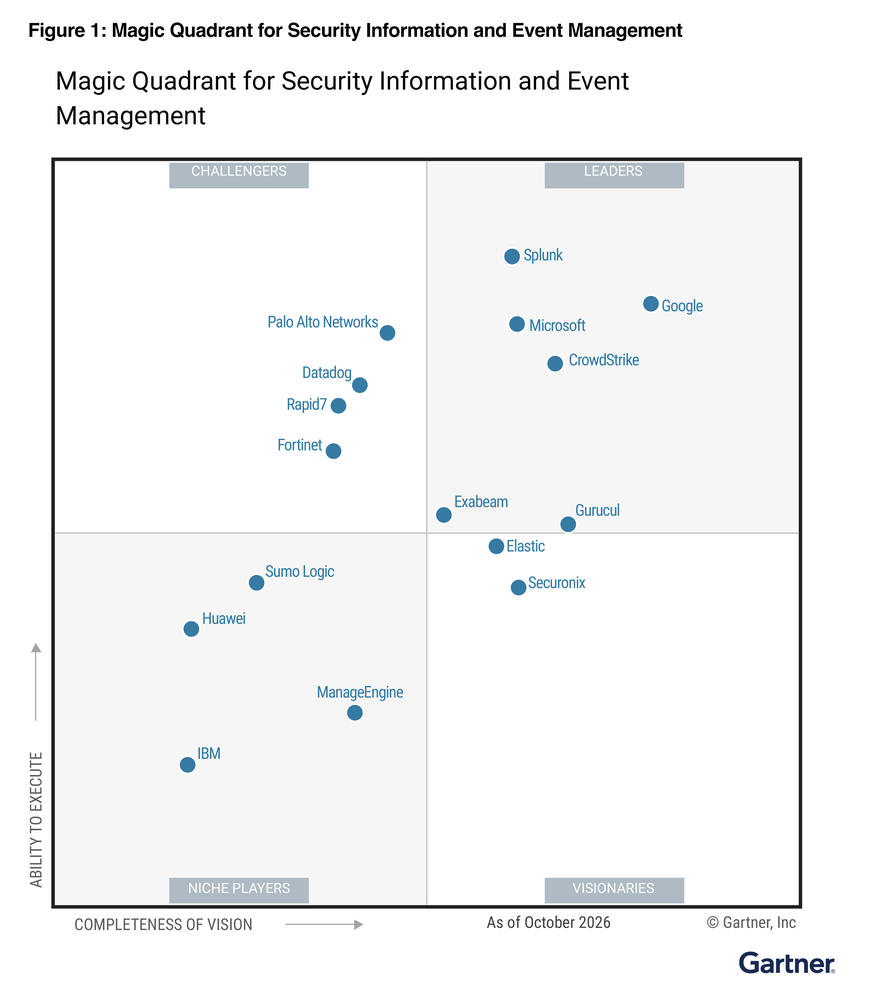
Today, we are proud to announce that Gartner has recognized Google as a Leader in the 2026 Gartner® Magic Quadrant™ for Security Information and Event Management (SIEM). Among the 15 vendors evaluated this year, Google was positioned furthest on “Completeness of Vision.”
Today’s threat landscape requires a new approach to security operations that can keep pace with the speed, scale, and sophistication of autonomous attacks. Traditional SIEM architectures centralized logs and alerts, but left analysts to manually stitch together context, write and maintain detections, and craft response playbooks.
Now, working alongside analysts, autonomous agents can reason over enterprise context and use frontline threat intelligence to compress detection and response cycles from days to seconds.
Advancing the agentic SOC across threat investigation, detection, and response
We feel our placement in the 2026 Leaders Quadrant reflects our rapid pace of engineering innovation in Google Security Operations. Since last year’s Magic Quadrant report, we’ve focused on turning the agentic SOC from vision into daily reality for our customers, helping security teams scale their expertise and outpace attackers. We expanded Gemini in Security Operations from a helpful assistant into a team of purpose-built agents, including the Triage and Investigation agent, Threat Hunt agent, Detection Engineering agent, and Third-party Context agent. We also introduced agentic automation to orchestrate automated actions in playbooks with agents.
Security teams are also able to assess their exposure to breaking threats, ranging from the Emerging Threats Centers to Mandiant rule packs and other curated detections, hunt and analyze threats faster using familiar syntax with GoogleSQL in Search, and run simplified operation at scale through native Data Processing Pipelines, the Health Hub, and a unified investigation and case management experience.
Measurable speed and real-world impact in the SOC
The shift to an agentic SOC with Google Security Operations is already delivering quantifiable time savings and operational relief for defenders. “Since implementing Google SecOps, we’ve cut false positives by 42%—exceeding all our expectations. Our analysts no longer spend their days validating noise on glass. Instead, they’re focused on solving complex problems and building proactive protections across our 100-year-old enterprise,” said David Nagel, global CISO, Genuine Parts Company.
Traditional detection engineering — which requires reverse-engineering attacks, manually authoring rules and validating coverage before pushing to production — requires intense resourcing from busy security teams. Our Detection Engineering agent transforms this workflow by automating rule creation and simulating threat coverage on demand. This can enable organizations to compress the entire end-to-end testing and deployment lifecycle down to under 30 minutes.
In addition to streamlining detection engineering, Google Security Operations brings agentic capabilities to threat hunting. Deep threat hunting across months of historical telemetry has historically been a manual, labor-intensive process restricted to specialized hunt teams or senior analysts, often demanding up to a full day of dedicated effort per hunt.
The Threat Hunting agent uplevels the SOC by autonomously generating and executing comprehensive hunt plans directly from threat intelligence to uncover advanced adversaries and emerging tactics, techniques, and procedures (TTPs), helping customers complete in less than an hour what previously took a full day.
“With threats doubling every year, we have to fight machines with machines. Google SecOps and Gemini give our junior analysts ‘superpowers’ to act like senior threat hunters, cutting our response times from hours to minutes so LATAM flights stay on time and our passengers safe,” said André Pires Ferreira Magalhães, CISO, LATAM Airlines.
According to a new Business Value report from IDC, security operations teams using Gemini in Security Operations have achieved a 98% faster mean time to identify threats, a 50% reduction in impactful security incidents per month, and an 84% reduction in the time spent manually drafting security reports and incident summaries. Ultimately, these efficiency gains allow organizations to scale their defenses and redirect their most experienced, time-limited talent toward strategic security priorities.
Furthermore, those organizations saw a 319% three-year ROI and a 7-month payback, $5.4M average annual benefits per organization and 38.2% team efficiency gain from using Gemini in production.
Innovating alongside our customers
Recognition in the Gartner Magic Quadrant is ultimately a reflection of the security teams who rely on Google Security Operations every day and push us to set new standards. Your real-world feedback and hard-won operational insights help us turn cutting-edge technology into a true defender’s advantage.
To read the entire report and explore Google’s ranking along with the other vendors evaluated, download a complimentary copy of the 2026 Gartner® Magic Quadrant™ for SIEM.
Gartner, Magic Quadrant for Security Information and Event Management, Andrew Davies, Mitchell Schneider, Rustam Malik, Eric Ahlm, 8 November 2026.
GARTNER is a registered trademark and service mark of Gartner, Inc. and/or its affiliates in the U.S. and internationally, and MAGIC QUADRANT is a registered trademark of Gartner, Inc. and/or its affiliates and are used herein with permission. All rights reserved. Gartner does not endorse any vendor, product or service depicted in our research publications, and does not advise technology users to select only those vendors with the highest ratings or other designation. Gartner research publications consist of the opinions of Gartner’s research organization and should not be construed as statements of fact. Gartner disclaims all warranties, expressed or implied, with respect to this research, including any warranties of merc hantability or fitness for a particular purpose.