
Running frontier AI in production is demanding — accelerators to manage, latency to hold steady across continents, regulated data to keep in-region, and long-context requests to serve reliably. Claude on Google Cloud is built for exactly this.
Like Monet and water lilies, frontier models and the enterprise platforms are often better together. In our case, Claude brings the reasoning, and Google Cloud brings the managed infrastructure, global reach, and compliance posture that enterprises already run on. Calling Claude becomes operationally identical to calling any other Google Cloud service — same Identity and Access Management (IAM), same VPC Service controls, same observability — so teams are able to spend their time building features instead of running inference infrastructure.
This post walks through what Claude on Google Cloud delivers in production across four areas:
-
Managed infrastructure that gives engineers their time back
-
Global endpoints that hold latency low, and uptime high for a worldwide user base
-
Security and data-sovereignty controls inherited straight from Google Cloud
-
Serving-layer features that keep cost and performance optimized at scale.
Managed infrastructure that frees engineering time
Claude on Google Cloud runs on fully managed infrastructure, so enterprise teams ship features instead of building clusters. Compute provisioning, auto-scaling logic, load balancing, and failover at frontier-model scale are handled by the platform — work that would otherwise occupy multiple teams full-time.
Claude is available through Agent Platform’s Model Garden as a Model-as-a-Service offering, ready to use over standard REST / JSON over HTTP/1.1 or HTTP/2 endpoints. Invoking Claude is operationally identical to invoking any other Google Cloud service: the same IAM policies, the same VPC controls, and the same observability stack via Cloud Logging and Cloud Monitoring.
Serving Claude takes a few lines of Python using the AnthropicVertex client:
- code_block
- <ListValue: [StructValue([('code', 'from anthropic import AnthropicVertexrnrnclient = AnthropicVertex(rn project_id="your-project-id",rn region="us"rn)rnrnmessage = client.messages.create(rn model="claude-opus-4-8",rn max_tokens=1024,rn messages=[{"role": "user", "content": "Analyze this system architecture."}]rn)'), ('language', ''), ('caption', )])]>
The same AnthropicVertex client handles prompt caching, tool use, structured outputs, streaming, and adaptive thinking; for batch inference, use Vertex AI Batch Prediction. Authentication uses Application Default Credentials; requests automatically inherit your project’s IAM and VPC configuration.
Global reach with consistent latency and built-in failover
Serving a worldwide user base from a single endpoint produces high tail latency and a single point of failure. Most enterprises can’t replicate inference infrastructure across continents while keeping performance consistent.
Agent Platform exposes three endpoint types for Claude, each solving a different production requirement:
-
Global endpoints route requests to a region with available AI compute capacity. For example, if us-central1 is capacity-constrained, traffic redirects to europe-west1 or another region with available capacity. That’s automatic failover and geographic load balancing without application-side routing logic. Global endpoints are ideal for maximum availability and lowest cost.
-
Regional endpoints like us-east5 or europe-west1 keep prompts, completions, and intermediate state inside a specific geographical boundary, making it ideal for low latency and data-residency requirements.
-
Multi-region endpoints give U.S. or EU data residency without single-region dependency. They dynamically route across regional endpoints providing built-in resilience against regional outages and capacity constraints.
The diagram below shows how applications reach Claude through these endpoint types, and how the Agent Platform serving layer routes traffic to the Compute AI clusters across regions:
Serving Claude Models From Regional & Global Endpoints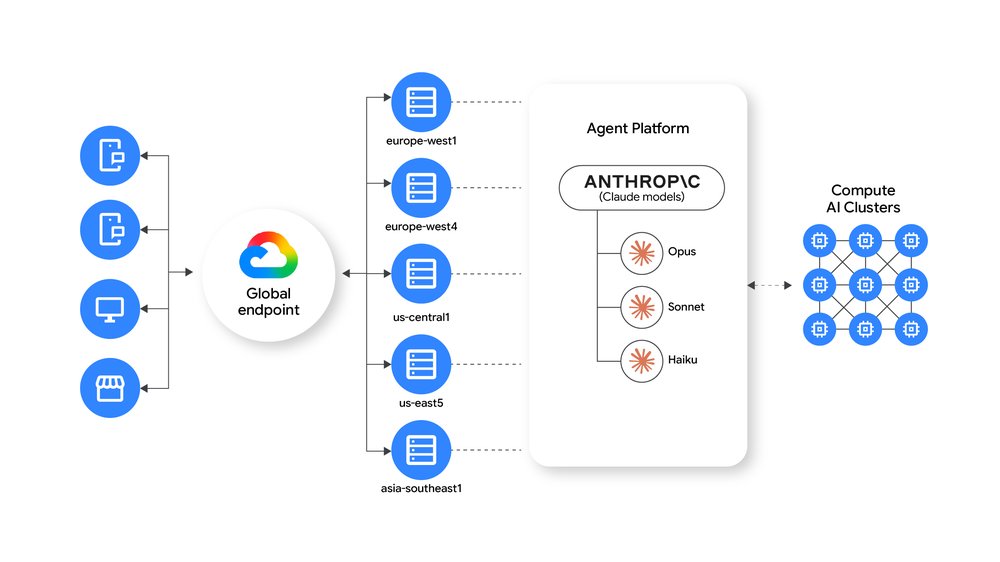
Serving Claude Models From Multi-Region Endpoints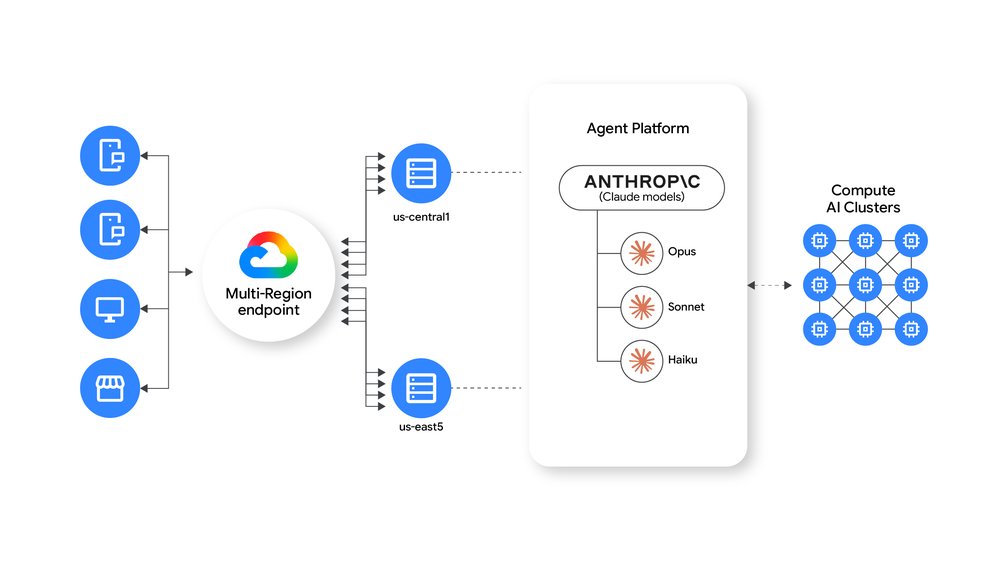
Serving Claude Models From Regional Endpoints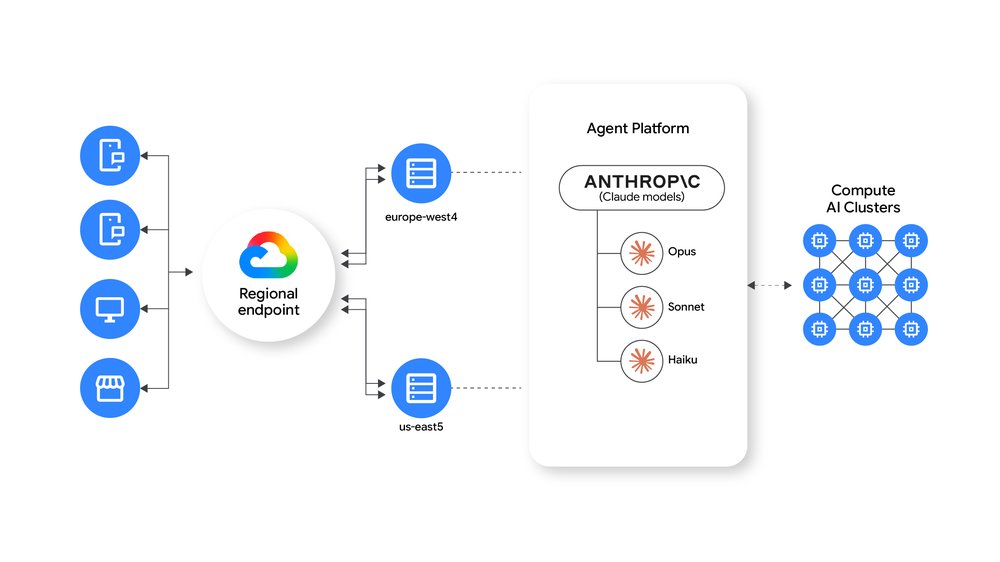
Enterprise security and data sovereignty built in
Regulated workloads — financial services, healthcare, and government — get enterprise-grade security and data sovereignty without trading compliance for convenience, and without re-engineering the hardest layer to control: inference, where prompts, completions, and intermediate state all flow through the serving stack.
Claude on Agent Platform inherits Google Cloud’s full security posture. FedRAMP High and HIPAA compliance enable deployment in government, healthcare, and financial services environments. VPC Service Controls let organizations define a perimeter around Agent Platform resources, preventing data exfiltration. IAM-native access control governs Claude endpoints with the same roles and policies that protect every other Google Cloud resource — no separate API keys to manage or rotate. Cloud Logging and Cloud Monitoring provide near real-time visibility into token usage, error rates, latency, and quota consumption.
Combined with the regional and multi-region endpoints above, this gives regulated customers a path to running frontier AI in production without re-auditing their compliance posture.
Optimized for cost and performance at scale
In production, cost and performance drive every architectural decision. Getting both right requires capabilities from two layers: Claude’s native model features, and Google Cloud’s serving infrastructure. Agent Platform supports both, so teams can optimize across the stack without managing them separately.
Claude-native capabilities, fully supported on Agent Platform
These features are built into Claude and available on Agent Platform without any additional configuration:
-
Prompt caching stores and reuses shared prefixes — long system prompts, legal documents, codebases — reducing request latency by up to 80% and cost by up to 90%.
-
Streaming responses over server-sent events deliver tokens as they are generated, critical for chat interfaces and coding assistants where perceived latency matters.
-
Extended and adaptive thinking lets Claude dynamically determine when and how much to reason through complex, multi-step problems — and allows users to dial the thinking effort directly, for example to control cost. Optimized for use cases like advanced code generation, mathematical reasoning, and multi-document analysis.
-
Extended context windows up to 1M tokens (for Claude Opus 4.6,Sonnet 4.6 and newer models) enable long-document analysis, large codebase reasoning, and multi-turn conversations at depth.
Google Cloud serving infrastructure
Agent Platform adds its own serving-layer capabilities on top of Claude’s native features:
-
Batch prediction handles large-scale offline workloads — document classification, content moderation, bulk summarization — asynchronously at lower priority and reduced cost.
-
Provisioned throughput reserves dedicated inference capacity for mission-critical workloads, isolating them from public traffic and ensuring predictable performance during peak demand.
-
Memory management and scheduling for long-context requests is handled at the infrastructure layer,.
Together, these two layers give teams the full range of optimization levers — from model-level efficiency to infrastructure-level capacity control — on a single, unified platform.
From inference to agents
The same infrastructure that serves Claude inference powers the agent layer of Agent Platform on Google Cloud. The build-and-register flow has three steps:
-
Build with Claude. Claude is well-suited as an orchestration backbone — its extended context window, native tool use, and adaptive thinking make it effective at planning multi-step tasks and delegating to sub-agents. Pick Claude Opus, Sonnet, or Haiku from the Model Garden, then build with the Agent Development Kit (ADK) — code-first in Python, Go, Java, or TypeScript — deploy to Agent Runtime, Cloud Run or Google Kubernetes Engine.
-
Deploy the Agent to a Runtime. Depending on your use case, select Agent Runtime, Google Kubernetes Engine or GKE Agent Sandbox to run your deployed agents.
-
Interoperate over A2A. The Agent2Agent protocol runs at 150+ organizations, letting a registered Claude-powered agent delegate tasks to agents from SaaS and other service providers.
The result: a planning agent built on Claude can orchestrate sub-tasks across the broader agent ecosystem, under unified IAM, fully auditable, on the same infrastructure that serves the underlying inference.
Start building
Open the Agent Platform console, enable Claude in the Model Garden, and make your first API call with the AnthropicVertex SDK. Add prompt caching, provisioned throughput, and other features as your workload demands. When you’re ready to go agentic, learn more about Claude on Agent Platform.
Reach out to your Google Cloud sales representative to discuss bringing Claude into your production environment at scale.