
For financial institutions, operational resilience has long been embedded in regulatory and supervisory expectations — to say nothing of the high expectations of consumers. With the implementation of the European Union’s Digital Operational Resiliency Act (DORA), those expectations have become even more stringent, with more explicit, harmonized, and evidence-driven requirements. Firms must now demonstrate that their critical business services and supporting digital infrastructures can withstand disruption, support coordinated response, and recover with control.
To meet these conditions, Deutsche Bank developed an AI-powered agentic resilience platform that modernized its regulatory tabletop resilience exercises at scale and turned manual preparation into context-aware and evidence-ready simulations grounded in actual operational data. The platform builds enterprise context from architecture, data flows, logs, incident history, alerting signals, and operational telemetry to generate scenarios, simulated operational evidence, structured session records, and regulator-ready artifacts.
At many large banks with operations that span interdependent applications, data flows, and third-party services, this is a critical and even existential shift. Across financial services, supervisory expectations are evolving and as they do, banks’ tabletop exercises must reflect their production dependencies, real operating conditions, and compliance with consistent evidence standards more directly.
As Deutsche Bank considered how to successfully and efficiently make this shift at scale, it looked to its long-time partner, Google Cloud, and its growing suite of agentic AI tools.
From tabletop exercises to resilience intelligence
With its agentic resilience platform, DB has been able to transform its tabletop exercises from manual preparation to a continuous intelligence model. And it’s been able to extend the same agentic layer to root-cause analysis when real operational context is needed.
This means that every scenario it runs is based on real enterprise signals. The platform can then reflect true system dependencies, failure patterns, and business impact instead of relying on static inputs that are more likely to return assumptions than real-time insights.
By using Gemini Enterprise Agent Platform, DB has been able to migrate this operational context into structured scenarios with clear timelines, decision points, and expected responses. This has ensured that each exercise is grounded in real system behavior that produces consistent, audit-ready evidence that meets regulatory expectations.
Dual orchestration for control and flexibility
In order to deliver both regulator-grade control and operational flexibility, DB’s platform introduced a dual-orchestration architecture that separates workflows into two complementary execution models.
First, for regulator-aligned execution, the bank is using LangGraph to ensure that it generates every scenario through a traceable, deterministic process — with clear lineage from input context to output — that supports the auditability required for supervisory review.
Next, for its adaptive and investigative scenarios, DB is using Google Agent Development Kit (ADK) to enable agent-driven coordination. This approach allows the bank’s platform to dynamically analyze conditions and generate responses without predefined execution paths.
Figure 1. Architecture for context assembly, orchestration, and scenario generation.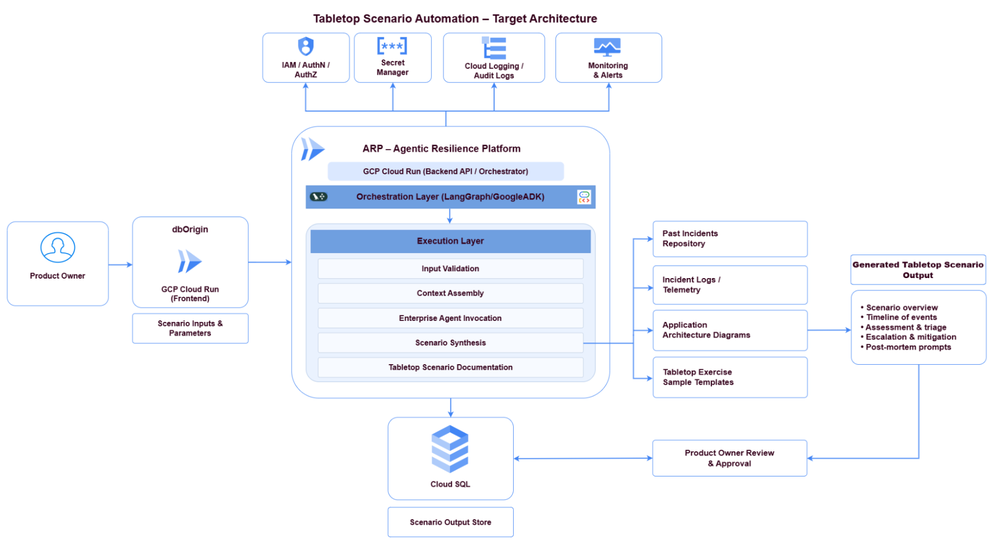
With this architectural separation, the platform can combine governed execution with adaptive investigation while preserving a common intelligence layer. The same agents and tools can reason over architecture, data-flow diagrams, logs, and code artifacts across tabletop scenario generation and related incident-analysis workflows. Importantly, this supports a consistent resilience model across both planned exercises and real operational events.
Deutsche Bank’s objective with this platform was to engineer a resilience model for critical financial systems that meets regulatory expectations — even within highly complex, distributed environments. By linking dynamically generated scenarios to real business context and combining governed orchestration with adaptive analysis, the platform has given us an intelligent, continuously adaptive model for operational resilience.” – Sanjay Tripathi, Managing Director, Global Head of Surveillance Technology & Compliance Cloud & AI Transformation Lead, Deutsche Bank
Powering generation and governance with Google Cloud
Google Cloud’s suite of agentic tools is providing the foundation for scaling Deutsche Bank’s platform across its many governed, enterprise-grade resilience workflows. Here’s how:
-
Cloud Run supports elastic execution of scenario and evidence-generation services.
-
Gemini Enterprise Agent Platform transforms operational context into structured resilience scenarios.
-
Google ADK enables adaptive agent coordination.
-
Cloud SQL provides durable persistence for scenarios, session artifacts, and review records.
Collectively, these services give DB support for the traceable generation, controlled execution, and persistent evidence record required for compliance review and continuous improvement.
Scalable, evidence-ready resilience testing
Every scenario generated by Deutsche Bank’s platform drives a structured tabletop session for the teams that run response, escalation, and recovery. Because these exercises are grounded in real enterprise context, they reflect operational reality while also strengthening consistency across teams and creating audit-ready evidence that meets regulatory expectations. For institutions that operate under DORA or similar frameworks, this makes it easier to demonstrate controlled, coordinated, and disciplined response at scale.
This model is now being applied across multiple DB portfolios, which is helping the bank establish more consistent and scalable resilience paradigms and a replicable blueprint for the broader financial sector.
In this model, root-cause analysis acts as the feedback loop between real incidents and future resilience testing. The resulting insights from production events can inform future tabletop scenarios, while exercise outcomes can strengthen response playbooks, escalation paths, and recovery readiness.
All of this extends the platform’s value from planned resilience exercises to real operational events while keeping scenario-based resilience testing as the primary use case.
As adoption expands, this platform brings consistency by embedding Google Cloud’s methodology for context-aware resilience. It eliminates fragmented manual approaches and establishes a cross-functional, AI-informed operating model across the bank.
Toward resilience intelligence
The bank’s next step is to extend this approach into a broader resilience intelligence layer, which is possible because it can deploy the same patterns to support playbook refinement, recovery-readiness assessments, and continuous validation of controls against evolving system conditions.
For financial institutions, this is a strategic shift. As systems become more distributed and regulatory expectations more demanding, banks must move from periodic resilience testing to continuous, intelligence-driven capabilities. At Deutsche Bank, Google Cloud is making that transition simple across the organization.
Learn more about Google Cloud’s methodology for context-aware resilience in this article.